
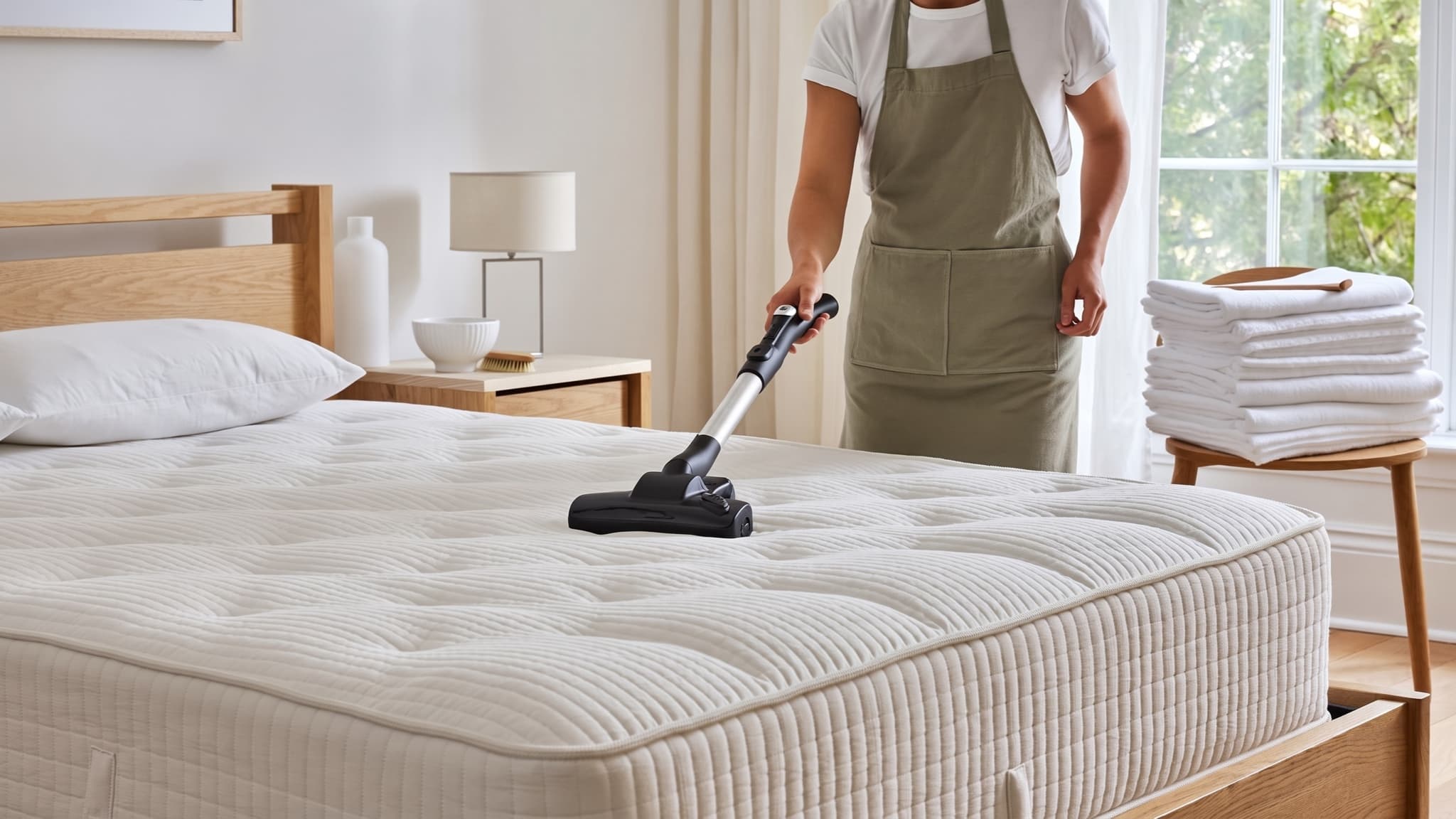
A mattress spends eight hours a night absorbing sweat, skin cells, and body heat, and unlike everything else in the bedroom it never goes through a wash cycle. The good news is that it doesn't need one. Almost everything a mattress collects sits in the top layer of fabric, where a vacuum and a box of baking soda can reach it.
Where mattresses actually get ruined is with water. Foam and fiber layers soak liquid up like a sponge and give it no way back out, which is how a well-meant scrub turns into a mildew smell that never leaves. Everything below — the basic refresh, the stain treatments, the urine protocol — is built around one idea: the least liquid that still does the job.
The basic clean: vacuum, treat, deodorize
This is the seasonal routine that handles a mattress with no major stains — the maintenance clean. Done every three to six months, it keeps odors, dust, and allergens from ever building to the point where a bigger intervention is needed.
- Strip everything — sheets, protector, pillowcases — and wash in the hottest water the care label allows
- Vacuum the top and sides with the upholstery attachment in slow, overlapping strokes
- Run the crevice tool along seams, piping, and tufting — that's where dust and skin cells collect most
- Spot-treat any stains by type (table below) using a barely damp cloth, never a direct pour
- Sprinkle a thin, even layer of baking soda over the whole surface and leave it 30 minutes to a few hours
- Vacuum the baking soda off with two slow passes, air the mattress out, then make the bed over a clean protector
The baking soda step earns its place: it adsorbs odor molecules and draws residual moisture out of the top layers, which is exactly what a slept-in mattress needs. The longer it sits, the more it pulls — half an hour is the minimum, a lazy Sunday afternoon is better.
Stain by stain: what actually works
Mattress stains are almost all biological — sweat, blood, urine — which means they respond to different chemistry than everyday dirt. The workhorse here is a simple mix: one cup of 3% hydrogen peroxide, three tablespoons of baking soda, and a single drop of dish soap, stirred gently in a spray bottle. Mist it lightly onto the stain, let it sit until it dries, then vacuum the residue. Mix it fresh each time and never cap it tightly for storage — peroxide breaks down and builds pressure in a sealed bottle — and test a hidden spot first, since peroxide can lighten some fabrics.
| Stain | What works | The catch |
|---|---|---|
| Sweat / yellowing | The peroxide mix, misted on and left to dry | Old, set yellowing may lighten but not vanish |
| Blood | Cold water first, blotted; then peroxide dabbed on with a cloth | Never warm water — heat sets protein stains for good |
| Urine | Blot hard, then an enzyme cleaner with full dwell time | Soap alone leaves odor behind — only enzymes break it down |
| Vomit | Remove solids, blot, enzyme cleaner, ventilate well | Work fast — stomach acid discolors fabric as it sits |
| Coffee, wine, food | Blot, then dab with a drop of dish soap in cool water | Rubbing spreads it — always press, lift, repeat |
Two things stay off the mattress entirely: bleach, which is too harsh for the fabric and nearly impossible to rinse out of something you can't submerge, and any mix of peroxide with vinegar, which creates peracetic acid — a lung and skin irritant you don't want anywhere near where you sleep.
The urine protocol, start to finish
Kids, pets, aging parents — urine is the mattress stain that brings most people to this page, and it's the one where order of operations matters most. First, blot. Press clean, dry towels into the spot with genuine force and hold, swapping for dry ones until they come up nearly dry. Every bit of liquid you lift now is liquid that never reaches the foam. Rubbing does the opposite: it drives urine deeper and spreads the edge of the stain.
Then reach for an enzyme cleaner — the kind sold for pet accidents works on human urine too. Enzymes are the only thing that actually breaks down uric acid; soap and water just dilute it, which is why a soap-scrubbed spot smells fine for a week and then comes back on the first humid day. Apply enough to reach where the urine went, keep the spot damp for the label's full dwell time — usually 10 to 15 minutes — then blot dry with the same body-weight pressure. Follow with baking soda over the area for a few hours, and vacuum. Skip ammonia-based cleaners entirely: to a pet, ammonia residue smells like urine, which reads as an invitation to mark the same spot again.
Memory foam changes the rules
Everything above assumes liquid is being kept to a minimum. On memory foam and all-foam mattresses, that goes double. Foam is a dense sponge with no airflow through it: whatever soaks in has essentially no path back out, and foam that stays damp inside develops a mildew smell no surface treatment can fix. Vacuum freely, use baking soda freely, but spot-clean with a lightly misted cloth rather than spraying the mattress itself — and never pour anything on it.
Heat is the other constraint. Most foam manufacturers advise against steam and heat because both can degrade the foam structure, so the steam-cleaning shortcut below is off the table here. If a foam mattress does take a serious spill, stand it on its side, aim a fan at the wet area, and give it a full day or two before it goes back on the frame. Damp foam laid flat stays damp.
Steam, sunlight, and the dust-mite question
On an innerspring or hybrid mattress, a handheld steamer is a legitimate deep-clean tool — and one of the few things that kills dust mites on contact. The technique matters: keep the head a few inches off the fabric, keep it moving in short passes so vapor touches the surface without wetting it, and give the mattress hours of open-window airflow before any bedding goes back on.
Dust mites deserve the attention if anyone in the house has allergies or asthma — the EPA lists them among the most common indoor asthma triggers, and bedding is where they concentrate. The reliable controls are unglamorous: wash sheets weekly in hot water, vacuum the mattress regularly, and consider a zippered allergen encasement, which starves mites of the skin cells they live on. Sunlight helps too — mites hate dry heat, and an afternoon of direct sun through an open window is the cheapest deodorizer there is.
How often to do all of this
A mattress doesn't need much — it needs regular. The schedule below keeps every session short, because nothing ever has months to build up.
| Frequency | What to do |
|---|---|
| Weekly | Wash sheets and pillowcases in the hottest water the label allows |
| Monthly | Wash the mattress protector; quick vacuum pass if pets sleep on the bed |
| Every 3–6 months | Full vacuum-and-baking-soda session, timed with rotating the mattress |
| Immediately | Any spill or accident — minutes matter more than method |
If you're building a rhythm for the whole house rather than just the bed, our house cleaning schedule guide slots mattress care into the seasonal tier, and the deep cleaning checklist covers everything else in the bedroom that only needs attention a few times a year. One more habit worth the money: a washable mattress protector. It turns almost every future stain on this page into a laundry problem instead of a mattress problem.
Keep the rest of the bedroom off your list
The mattress is a personal job — twenty minutes of vacuuming and a box of baking soda, a few times a year. What quietly eats weekends is everything around it: the dusting, the floors, the blinds, the bathroom down the hall, all the surfaces that feed dust back onto the bed you just cleaned. A recurring clean keeps that whole loop under control, so your seasonal mattress session is the only bedroom chore left on your list.
Our home cleaning service covers bedroom dusting, floors, and detail work on every visit, starting at $150 with the same cleaner every time. We're a background-checked, bonded and insured crew that has cleaned 1,200+ Puget Sound homes since 2022, now serving north King, Snohomish & Skagit counties — and every visit is backed by a 100% satisfaction guarantee. You can get a flat quote in about 60 seconds.