Glass shower doors fail slowly. They come out of the box invisible, pick up a faint film nobody notices for a few months, and then one day the light hits them sideways and the whole panel looks frosted. By that point most people reach for a glass spray built for windows — and it does almost nothing, because what's on shower glass isn't dust or fingerprints.
It's two different kinds of buildup, and each one has a specific fix. Get the diagnosis right, give the cleaner time to actually work, and the job takes twenty minutes instead of an afternoon of scrubbing that dulls the glass and doesn't clear it.
Soap scum or hard water? Diagnose first
Soap scum is what forms when soap — especially bar soap — reacts with the minerals in your water and mixes with body oils. It sits on the glass as a slightly greasy, gray-white film that smears if you rub it with a dry fingertip. Hard water spots are pure mineral: every droplet that dries on the pane leaves its dissolved calcium and magnesium behind as a white crust of overlapping rings. Homes on well water — common in outlying parts of Snohomish and Skagit counties — see the mineral side of the problem much faster than homes on city water.
| What you see | What it is | What removes it |
|---|---|---|
| Greasy gray film that smears | Soap scum — soap, minerals, and body oils | Vinegar + dish soap mix, 10–15 min dwell |
| White rings and chalky crust | Hard water deposits — dried calcium and magnesium | Undiluted vinegar kept wet on the glass, then baking soda paste |
| Smooth haze no cleaner changes | Etching — minerals have eaten into the glass surface | Nothing in a bottle — polishing or replacement; prevent it instead |
The quick test: rub a spot with a fingertip. Smears means scum. Feels rough or crusty means mineral deposits. Feels perfectly smooth but stays hazy means etching — and that changes what's worth your effort, so check before you commit an hour to scrubbing.
The vinegar method, step by step
White vinegar works because it's a mild acid, and both soap scum and water spots are alkaline mineral films — the acid dissolves what scrubbing only smears around. The step almost everyone skips is dwell time. Acid needs contact minutes to break down mineral bonds; spray-and-immediately-wipe is why people conclude vinegar “doesn't work.”
- Warm a cup of white vinegar (about 30 seconds in the microwave) — warm acid cuts mineral film faster
- Mix 1:1 with water in a spray bottle and add a squirt of dish soap for the body-oil half of soap scum
- Spray the dry glass top to bottom and let it sit 10–15 minutes, re-misting any patches that dry out
- Scrub in circles with a non-scratch sponge or microfiber cloth — the film should wipe away, not fight back
- Rinse with warm water, including the frame, so acid doesn't sit on the aluminum
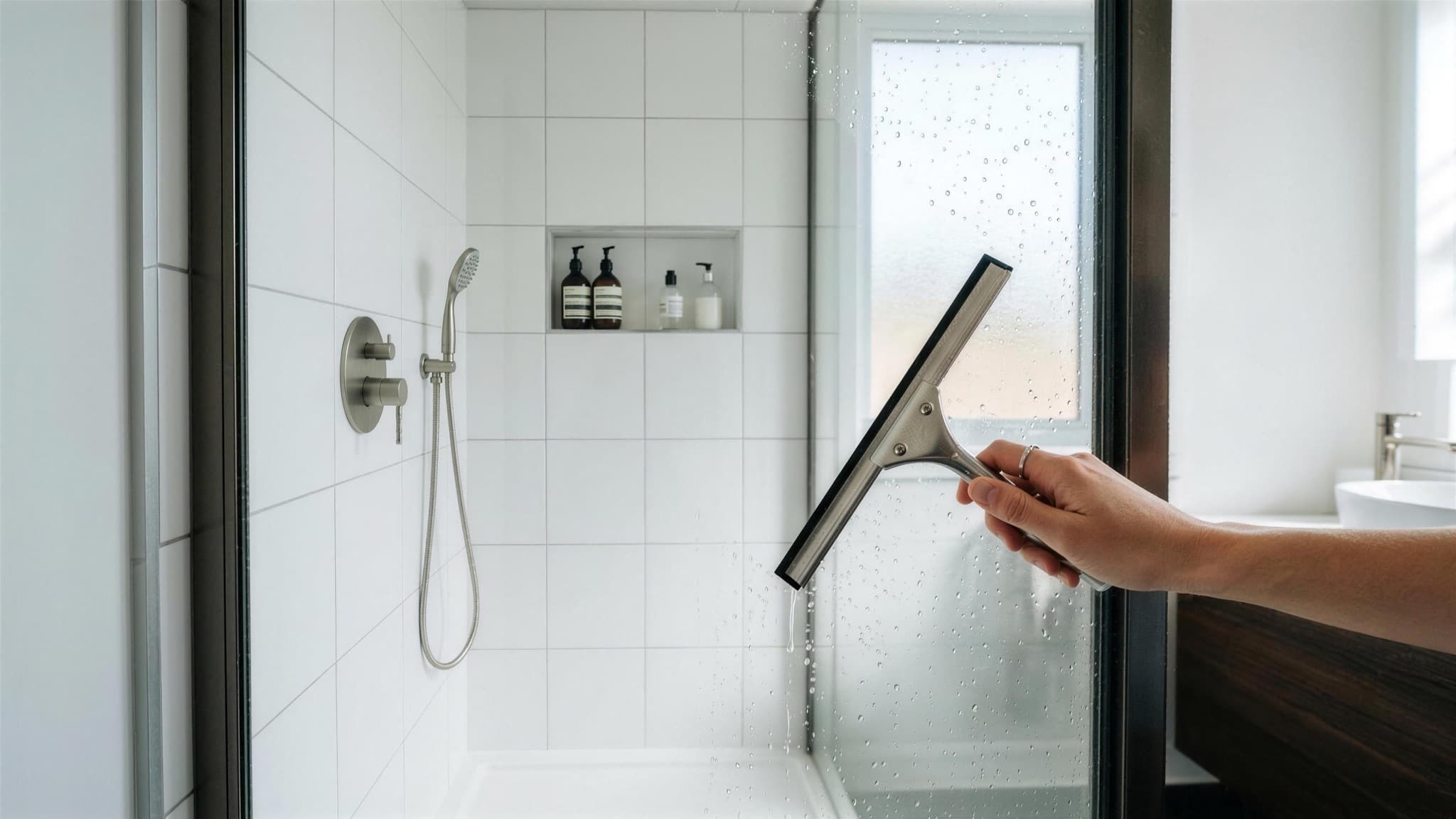
- Squeegee or dry with microfiber — rinse water that air-dries puts fresh spots right back on clean glass
Two cautions. Never combine vinegar with bleach or any chlorine product — the reaction releases chlorine gas, which is genuinely dangerous in a closed bathroom, not just unpleasant. And keep vinegar off natural stone: if the shower curb or surround is marble, travertine, or limestone, acid etches it on contact, so spray onto the sponge rather than the glass and control where it runs.
Stubborn buildup: add the baking soda paste
If the vinegar pass leaves crusty patches, escalate with baking soda rather than a harsher chemical. Mix baking soda with just enough water to make a thick paste, spread it over the remaining spots with a damp sponge, and let it sit 10 to 15 minutes. Baking soda is abrasive enough to break down softened mineral crust but softer than glass, so it won't scratch the pane the way scouring powder or steel wool will.
Work the paste in small circles, then mist vinegar solution over it — the fizz helps lift the loosened residue — and rinse everything away. One vinegar round plus one paste round clears almost any door that hasn't etched. What survives both is usually not deposit at all, which brings us to the bad news section.
The haze that never comes off: etching
Left long enough, mineral deposits stop sitting on glass and start reacting with it, eating shallow pits into the surface. That's etching, and it's permanent — the haze is damage, not dirt, so no cleaner in any bottle will remove it. The tell: the glass feels completely smooth, the haze is even rather than ring-shaped, and it looks identical before and after your best cleaning effort.
The honest options are professional glass polishing with cerium oxide, replacing the panel, or living with it and protecting what clarity is left. If your door is only lightly hazed, treat that as the warning shot: everything in the prevention section below is what stops light etching from becoming frosted glass.
What not to use on shower glass
Most shower door damage we see wasn't neglect — it was an aggressive fix. Scouring powders and steel wool scratch glass permanently, and every scratch becomes a groove that collects minerals faster. Razor blades, a common online tip, are risky on two counts: many modern doors carry a factory hydrophobic coating a blade will strip in streaks, and a blade at the wrong angle scratches even bare glass. Melamine erasers are gentler but still abrasive — fine on old uncoated panes, capable of dulling a coated one.
On chemistry: skip ammonia-based glass sprays in an enclosed shower — the fumes concentrate fast in a small wet box — and never chase one cleaner with another without rinsing in between. If you'd rather buy than mix, a cleaner formulated for soap scum works; the EPA's Safer Choice directory lists products vetted for safer ingredients, which matters more than usual in a room this small and this poorly ventilated.
Don't forget the tracks and frame
On sliding doors, the bottom track is where everything the glass sheds ends up — soap residue, minerals, and the pink biofilm that thrives in standing water. Lay strips of paper towel soaked in vinegar solution along the track, leave them 30 minutes, then lift them out with most of the grime attached. An old toothbrush clears the corners, a cotton swab gets the roller channels, and a final wipe with a dry cloth keeps water from re-pooling.
Wipe the frame with the diluted spray and rinse it promptly — prolonged acid contact can discolor anodized aluminum. While you're down there, check the sweep (the rubber or vinyl strip along the door's bottom edge). If it's slimy, pull it and soak it in warm soapy water; if it's cracked, replacements are inexpensive and it's the part that keeps water off the bathroom floor.
The prevention routine that ends this chore
Every hour spent restoring shower glass buys you the chance to never do it again, because prevention here is almost embarrassingly cheap. Minerals can only build up when water dries on the pane — remove the water, and there is nothing to clean.
| Frequency | What to do |
|---|---|
| Daily | Squeegee after the last shower; run the fan or crack a window while the room dries |
| Weekly | Quick spray of the vinegar solution, one-minute dwell, rinse, squeegee |
| Monthly | Full clean: glass both sides, frame, tracks, sweep, and a fresh coat of repellent if you use one |
Two upgrades worth considering. A hydrophobic glass treatment (the same chemistry as automotive rain repellents, sold in shower-safe versions) makes water sheet off instead of sitting, so even lazy squeegee weeks stay spot-free — reapply every couple of months. And switching from bar soap to liquid body wash removes the main ingredient of soap scum entirely. Ventilation matters too: the same trapped humidity that spots the glass feeds mildew everywhere else, which is exactly the territory our bathroom mold guide covers, and where the shower fits into the rest of the house is mapped out in the deep cleaning checklist.
When to hand it to a crew
One door with light film is a twenty-minute job. What eats a Saturday is the accumulated version — two or three showers, crusted tracks, stone surrounds that rule out the easy chemistry, and glass that needs the full two-round treatment. That's where a recurring clean quietly wins: the glass gets a proper pass every visit, so it never drifts far enough from clear to need a restoration project.
Our home cleaning service includes shower glass, tracks, and full bathroom detail on every visit, starting at $150 with the same cleaner every time. We are a background-checked, bonded and insured crew cleaning homes across Greater Seattle and the North Sound since 2022, serving north King, Snohomish, and Skagit counties — from Seattle, Bellevue, and Kirkland up through Everett, Marysville, and Arlington to Mount Vernon and Burlington. Every visit is backed by a 100% satisfaction guarantee, and you can get a flat quote in about 60 seconds.