
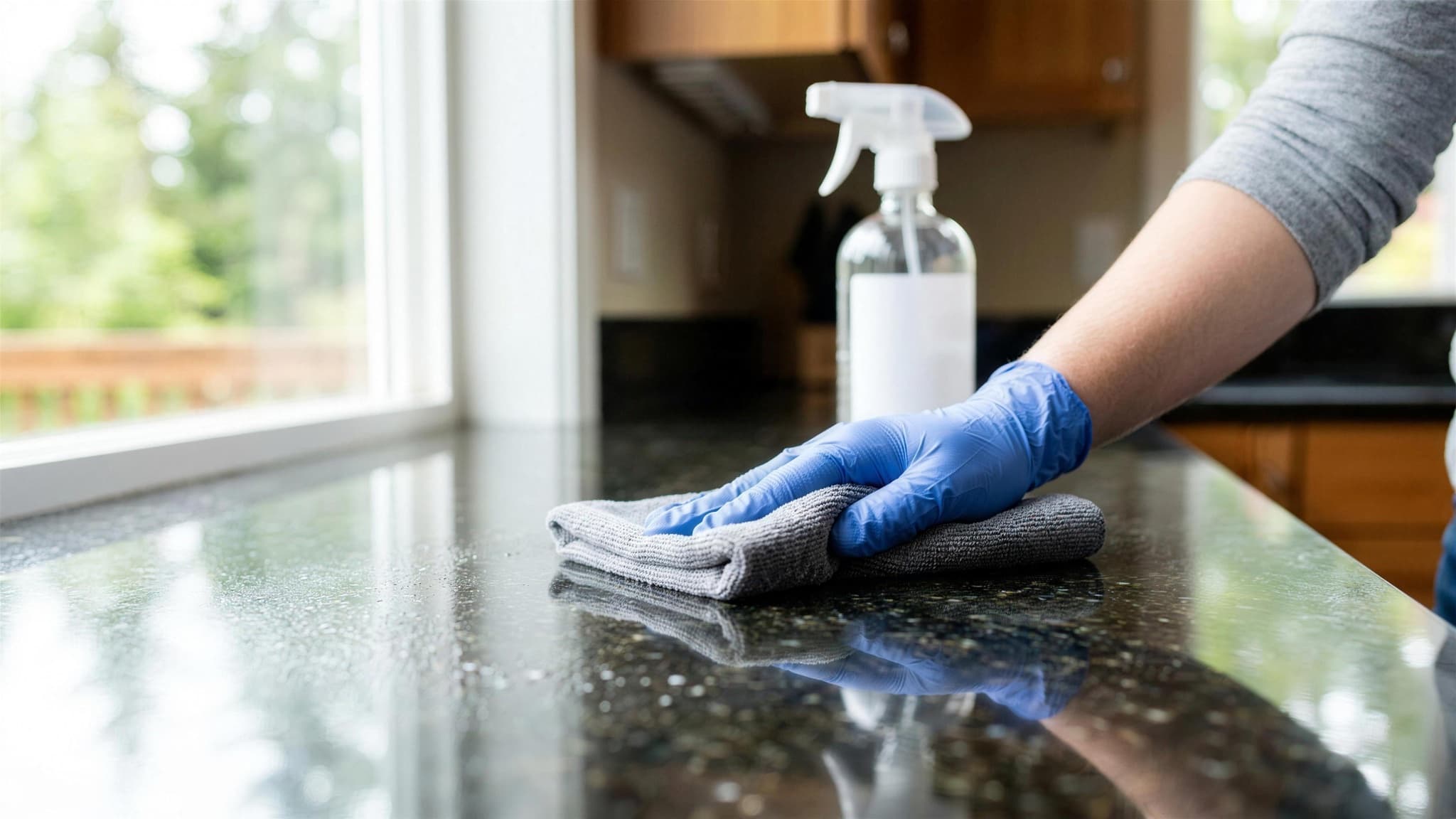
The fastest way to clean granite countertops is warm water, a few drops of mild dish soap, and a microfiber cloth — wipe, rinse, buff dry, done in under two minutes. What actually trips people up is everything after that: which products quietly break down the sealer, how to lift a stain that soap and water will not touch, and how to tell there is a problem before a ring shows up overnight.
Granite is forgiving until it is not. It handles heat, knives, and daily use in a way laminate and butcher block never will, which is exactly why so many kitchens have it. But it is still a natural stone with a topical sealer standing between the pores and everything you spill on it, and products that are perfectly fine on tile or quartz can strip that sealer without leaving a mark you would notice — until the day a glass of wine leaves a ring by morning. Below is the routine that keeps a sealed granite counter looking new, what to reach for and what to avoid, how to treat a stain that has already set in, and how to check whether your seal needs a refresh before it lets you down.
Why granite needs different care than laminate or quartz
Granite is quarried stone, not a manufactured surface, and that changes the rules. Laminate is a plastic layer that mostly just needs wiping. Quartz is engineered with resin binders that make it close to non-porous. Granite sits in between: extremely hard and heat-resistant, but naturally porous underneath, which is why every granite counter gets a topical sealer at installation — it fills the pores and keeps liquids from soaking straight in.
That sealer is the part that needs protecting, not the stone itself. Granite is actually more chemical-resistant than marble or limestone, since it is not calcium-based — it will not etch into a dull ring the instant lemon juice touches it. What acidic and abrasive cleaners do instead is slowly wear down the sealer coat sitting on top, and once that is gone, the stone underneath is exposed and stains for the first time. It is a slow failure, which is exactly why the wrong daily habits can run for months before the damage becomes obvious.
The best way to clean granite countertops every day
You do not need a specialty product for daily use. Plain dish soap beats every store-bought granite spray we have tried, and it is what our crews reach for on a routine kitchen pass.
- Add a few drops of mild, unscented dish soap to warm water in a spray bottle or bowl
- Spray or wipe the surface, working in small sections rather than the whole counter at once
- Wipe with a soft microfiber cloth — never a scrub sponge or anything abrasive
- Go over the counter again with a clean, damp cloth to lift any soap residue
- Buff dry immediately with a second, dry microfiber cloth — this is the step people skip, and the one that stops water spots before they start
- Repeat any day the counter is used for food prep — once it is a habit, the whole pass takes under two minutes
That is the entire daily routine, and it fits naturally into a nightly kitchen wipe-down rather than a separate chore — see our realistic house cleaning schedule for where it fits alongside everything else that needs a daily pass.
What to clean granite countertops with (and what to avoid)
Most of the confusion around granite care comes down to reaching for whatever is already under the sink. Here is how the common options actually stack up on sealed granite.
| Cleaner | Best for | Watch out |
|---|---|---|
| Warm water + mild dish soap | Everyday cleaning on all sealed granite | The safe daily default — always buff dry afterward |
| 70% isopropyl alcohol (diluted 1:1) | Occasional disinfecting of food-prep zones | Won't strip the sealer the way bleach can; still spot-test first |
| pH-neutral stone cleaner | A deeper weekly wipe-down on busy kitchens | Skip versions with added wax or shine boosters — they build a film over time |
| Vinegar or lemon juice | Nothing, on granite | Breaks down the sealer with repeated use, even though it won't etch the stone itself |
| Bleach or abrasive powders | Nothing, on polished granite | Can discolor the stone or scratch the polish — see below |
What never to use on granite countertops
None of the products below will ruin your counter on contact. The damage is cumulative, which is exactly why they are so easy to keep using for months before a stain shows up out of nowhere.
- Vinegar and lemon juice — the acid slowly breaks down the sealer, opening the stone to stains
- Bleach — can discolor natural stone and react with the resin fillers used to patch small fissures in some slabs
- Ammonia-based glass cleaners — fine once in a while, but daily use dries out the sealer over time
- Abrasive powders and scouring pads — scratch the polish, and a dulled patch actually holds dirt better than a smooth one
- Hard-water descalers and rust removers — usually strongly acidic and made for fixtures, not stone
A simple rule covers all of it: if the label does not say “safe for natural stone,” treat it as a no for the kitchen counter.
How to clean stains from granite countertops
Sealed granite resists most spills, but a stain that sits overnight — cooking oil, red wine, coffee, an overflowing pot — can still soak past the sealer into the stone itself. The fix depends on what caused it.
- Oil-based stains (grease, butter, cooking oil) darken the stone and spread at the edges
- Water-based stains (wine, coffee, tea, juice) usually sit on the surface rather than spreading
- Rust stains (cast iron, cans, metal furniture legs) need a rust-specific poultice, never a standard rust remover
For oil and water-based stains, mix baking soda with a little water into a paste about the thickness of peanut butter. Spread it over the stain roughly a quarter-inch thick, cover it with plastic wrap, tape down the edges, and leave it for a full 24 hours — the baking soda draws the stain back out of the stone as it dries. Wipe away, rinse, and buff dry. For a stubborn water-based stain on light-colored granite, a few drops of hydrogen peroxide mixed into the paste helps lift the color faster. Whatever the stain, test the poultice in an inconspicuous corner first, and never mix bleach into a poultice on colored or dark granite — it can lighten the stone along with the stain.
How to disinfect granite countertops safely
Soap and water clean, but they do not disinfect, and a counter that touches raw meat or produce needs that step occasionally. Skip the bleach spray — mix 70% isopropyl alcohol with water in a 1:1 ratio in a spray bottle, spray the surface, and let it sit for about a minute so the alcohol has time to work. Wipe dry with a microfiber cloth. Alcohol evaporates cleanly and will not strip the sealer the way bleach or vinegar can, which is why it is the disinfecting method most cleaning professionals actually use on sealed stone. Reserve it for the times it is genuinely needed — after handling raw chicken, before setting out food for guests — rather than an everyday step; the daily soap-and- water pass is already doing most of the work.
How to clean and seal granite countertops (the water-drop test)
Every granite counter eventually needs to be resealed, and cleaning technique only matters as much as the seal underneath it. The good news is that checking it takes about thirty seconds.
- Pour a tablespoon of water onto the counter in a few spots, including near the sink and stove
- Watch it for 15 to 20 minutes — water that beads and sits on top means the seal is doing its job
- Water that darkens the stone or soaks in within a few minutes means the seal has worn through
- Run this test every 6 to 12 months, and again anytime you switch daily cleaners
Resealing itself is a weekend project, not a professional-only job. Clean the counter thoroughly and let it dry completely — any trapped moisture gets sealed in along with it. Apply a penetrating granite sealer in thin, even coats with a soft cloth, following the product's dwell time, then wipe away any excess before it dries on the surface. Most granite needs resealing every 1 to 2 years; honed, matte finishes and counters that see heavy use near the sink and stove may need it sooner.
Quick reference: granite countertop dos and don'ts
If nothing else sticks, this is the short version worth keeping on the fridge.
| Do this | Not this |
|---|---|
| Wipe daily with warm water and a few drops of mild dish soap | Reach for vinegar, lemon, or an all-purpose acidic spray |
| Buff dry with a clean microfiber cloth | Let it air-dry and leave water spots behind |
| Wipe up oil, wine, and coffee as soon as you notice it | Let a spill sit overnight “to deal with tomorrow” |
| Disinfect occasionally with diluted isopropyl alcohol | Disinfect with bleach or ammonia as a matter of routine |
| Lift stuck-on spots with a soft cloth and dwell time | Scrub with an abrasive pad, powder, or steel wool |
| Run the water-drop test every 6 to 12 months | Assume a shiny counter means the seal is still fine |
When to hand your kitchen to a crew
Most granite maintenance really is a two-minute daily habit, and an occasional stain or reseal is a solo weekend job. Where a crew earns its keep: a kitchen that has gone long enough without care that soap and water alone no longer cut it, a full pre-listing or move-out clean where every surface needs to look new — see our move-out cleaning checklist for what that covers — or simply reclaiming the few minutes a day this adds up to. A kitchen that has not seen a real reset in a while is also exactly what a deep clean is built for.
Our recurring home cleaning already includes a granite-safe kitchen pass — the right products, the right technique, every visit — as part of the routine, not an upsell. We are a background-checked, bonded and insured crew cleaning homes across Greater Seattle and the North Sound since 2022, serving north King, Snohomish, and Skagit counties today, from Everett and Marysville up through Mount Vernon and Burlington. Home cleaning starts at $150 with a flat quote up front, first-time clients save $40, and every visit is backed by a 100% satisfaction guarantee. You can get a flat quote in about 60 seconds.