Hardwood is the surface people are most afraid of cleaning wrong — and the fear is justified, because the two most popular “hacks” for it, vinegar water and steam mops, are exactly what dulls and clouds a finish over time. The actual routine is easier than either: get the grit off dry, then wipe the film off with the least water that will do the job.
Below: the thirty-second test that tells you which cleaners your floor can handle, the tools worth owning, the step-by-step damp-mop method, the products that quietly wreck polyurethane, and how to deal with the scuffs, cloudy spots, and wet-shoe grit that a rainy Puget Sound winter drags across every floor in the house.
Know your finish before you mop
Every cleaning decision downstream depends on one question: is there a surface finish — polyurethane or the aluminum-oxide coating on prefinished boards — standing between the water and the wood? Almost every floor installed or refinished since the 1970s has one, and those floors tolerate a damp mop. Older floors that have never been refinished often have a penetrating oil or wax finish instead, and on those, water is the enemy outright.
The test takes thirty seconds. Put a single drop of water on the floor in a low-traffic spot. If it beads up and sits there, you have a surface finish — everything in this guide applies. If it soaks in and darkens the wood or turns the spot white within a few minutes, you have oil or wax: vacuum and dust-mop only, restore shine with a solvent-based wax cleaner and fresh paste wax, and keep every damp pad in the closet.
The tools that actually work
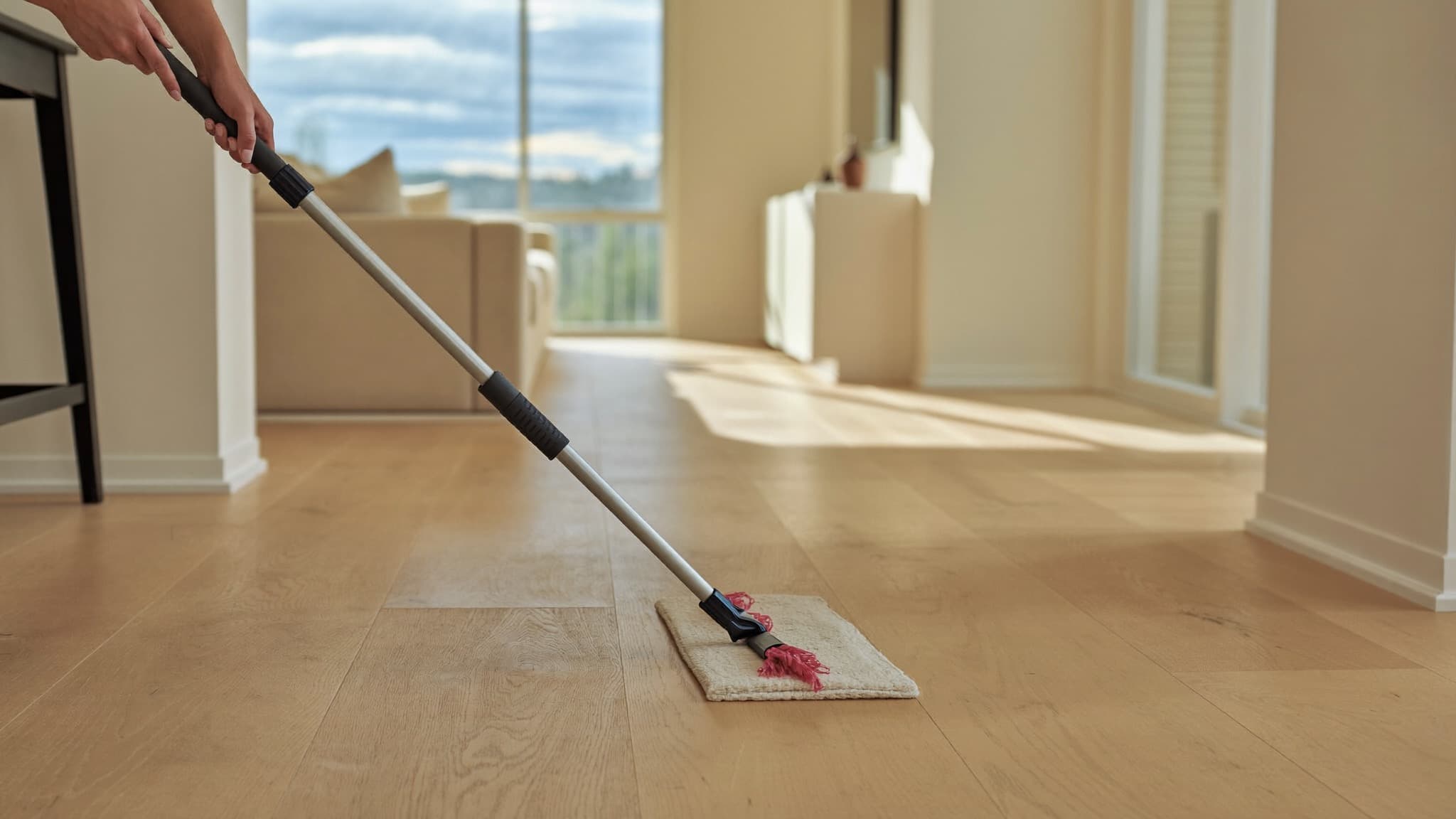
Grit is the real threat to a hardwood finish — every step on a sandy floor works like fine sandpaper — so the dry tools matter more than the wet ones. A microfiber dust mop lifts grit and pet hair fast; a vacuum on its hard-floor setting, with the beater bar off, does the same job and empties the corners. For the wet pass, a flat microfiber mop and a pH-neutral cleaner made for hardwood are the whole kit.
| Tool | Best for | Skip it if |
|---|---|---|
| Microfiber dust mop | The every-day-or-two grit pass on traffic lanes | Never — it's the tool that saves the finish |
| Vacuum, hard-floor setting | Weekly full pass — corners, edges, under furniture | The beater bar won't switch off — it dents and scratches finish |
| Flat microfiber mop, misted | The damp pass — film, footprints, kitchen stickiness | The floor failed the water-drop test — oil or wax finishes stay dry |
| pH-neutral hardwood cleaner | Every damp pass — it cleans without touching the finish | The label says shine, polish, or restore — that's residue in a bottle |
What stays in the closet: the string mop and bucket (too much water), the steam mop (worse — see below), and anything labeled oil soap or floor polish, which build a film on polyurethane that streaks with every pass and grabs dirt.
The step-by-step method
The order is the method: dry, then barely damp, never wet. Mopping a gritty floor grinds the grit in; flooding a clean one pushes water into the seams. Get both right and the whole job takes minutes.
- Dust-mop or vacuum the full floor first — grit under a damp pad scratches the finish
- Mist pH-neutral hardwood cleaner onto the mop pad, not the floor — no pouring, no bucket
- Mop with the grain in small sections, roughly a few boards wide at a time
- Swap or rinse the pad when it loads up — a dirty pad just redistributes film
- Spot-clean sticky spills right away with a damp cloth, then dry the spot — don't wait for mop day
- Each section should air-dry within a minute or two — if you can see standing water, the pad is too wet
That drying check is the whole safety margin. A finish shrugs off dampness that evaporates in a minute; it's water that sits — in seams, in gaps, under a rug on a just-mopped floor — that swells boards and clouds finish from below.
The products that quietly ruin hardwood
Vinegar first, because it's the most recommended and the most misunderstood. It's an acid, and while one pass won't visibly hurt anything, years of vinegar mopping etch and dull a polyurethane sheen into the flat, cloudy look people blame on age. It's also simply a weak cleaner for the oily film kitchens deposit. Steam mops are worse and faster: pressurized vapor drives moisture through board seams and micro-cracks in the finish, whitening it from underneath and cupping board edges — damage several flooring manufacturers call out by name as a warranty voider.
The subtler saboteurs are the shine products. Oil soaps, wax-based polishes, and “restorer” sprays layer a soft film over polyurethane that streaks, smears underfoot, and grabs dirt — and when the floor eventually needs a professional recoat, that residue can keep the new finish from bonding, turning a routine buff-and-recoat into a full sanding. Ammonia and alkaline all-purpose cleaners round out the do-not-use list; they dull finish from the other end of the pH scale. If a product doesn't say pH-neutral and hardwood on the label, it doesn't touch the floor.
Scuffs, cloudy spots, and pet stains
Scuffs sit on the finish, and the gentlest tool wins: a dry microfiber cloth or a clean tennis ball rubbed over the mark lifts most of them with zero product. Black heel marks that resist get a spray of hardwood cleaner on the cloth and friction with the grain. Save melamine erasers for a last resort — they can dull the sheen in a spot that ends up more visible than the scuff.
Discoloration is about depth. A white or cloudy mark is moisture in the finish — recent ones often fade as they dry out over days, and gentle buffing helps. A dark brown or black stain means liquid got through to the wood itself: old pet accidents and long-standing water are the usual causes, and no cleaner reverses them — that's a spot sand and refinish. For fresh pet accidents, blot fast, clean with a damp cloth and a little hardwood cleaner, dry the spot, and the floor usually keeps no record of it. The difference between a non-event and a permanent stain is almost always how long the liquid sat.
Rain, grit, and wet shoes: the Puget Sound problem
Around here the floor's worst enemy walks in the door from October to May: wet shoes carrying grit. Two mats at every exterior door — a coarse scraper mat outside, an absorbent walk-off mat inside — remove most of it before it reaches the wood, and a shoes-off habit removes the rest. Wipe up tracked-in rainwater when you see it rather than letting it dry in the entry seams, and give traffic lanes the dust-mop pass more often in the wet months, not less.
Two more habits that out-earn any cleaner: felt pads under every chair and table leg, checked a couple of times a year because they wear through and hide grit — and calm about seasonal gaps. Thin gaps that open between boards when the heat runs all winter and close again in summer are the wood breathing with indoor humidity, not a cleaning or repair problem.
How often to clean hardwood floors
Hardwood rewards frequent light attention over rare heavy sessions — the dry pass is quick and does most of the protecting, while the damp pass only needs to happen when there's actually film to remove.
| Frequency | What to do |
|---|---|
| Every day or two | Dust-mop the traffic lanes and entries — the two-minute grit pass |
| Weekly | Vacuum the full floor on the hard-floor setting; damp-mop the kitchen and entry |
| Monthly | Damp-mop every hardwood room; check felt pads and door mats while you're down there |
| Every few years | Screen and recoat before the finish wears through — maintenance, not cleaning |
One boundary worth knowing: when traffic lanes look gray and dull no matter how they're cleaned, the finish itself has worn through and no product will bring it back — that's recoat territory, and polish only makes the eventual job harder. If you're slotting floors into a whole-home rhythm, our house cleaning schedule guide covers the daily-to-seasonal cadence for every room, and the deep cleaning checklist shows where floor detailing fits alongside everything else.
When to hand it to a crew
One room is a ten-minute job. A whole house of hardwood — dust pass, damp pass, edges, corners, under the furniture — is the kind of recurring chore that quietly eats a weekend morning every week, and it's also the one where shortcuts (a wetter mop, a skipped dry pass) do cumulative damage. A recurring clean puts the floors on a schedule where the grit never gets the chance to grind in.
Our home cleaning service includes hardwood-safe floor care — dry pass first, pH-neutral products, barely damp pads — on every visit, starting at $150 with the same cleaner every time. We are a background-checked, bonded and insured crew that has cleaned Puget Sound homes since 2022, serving north King, Snohomish, and Skagit counties — from Seattle, Bellevue, and Kirkland up through Everett, Marysville, and Arlington to Mount Vernon and Burlington. Every visit is backed by a 100% satisfaction guarantee, and you can get a flat quote in about 60 seconds.