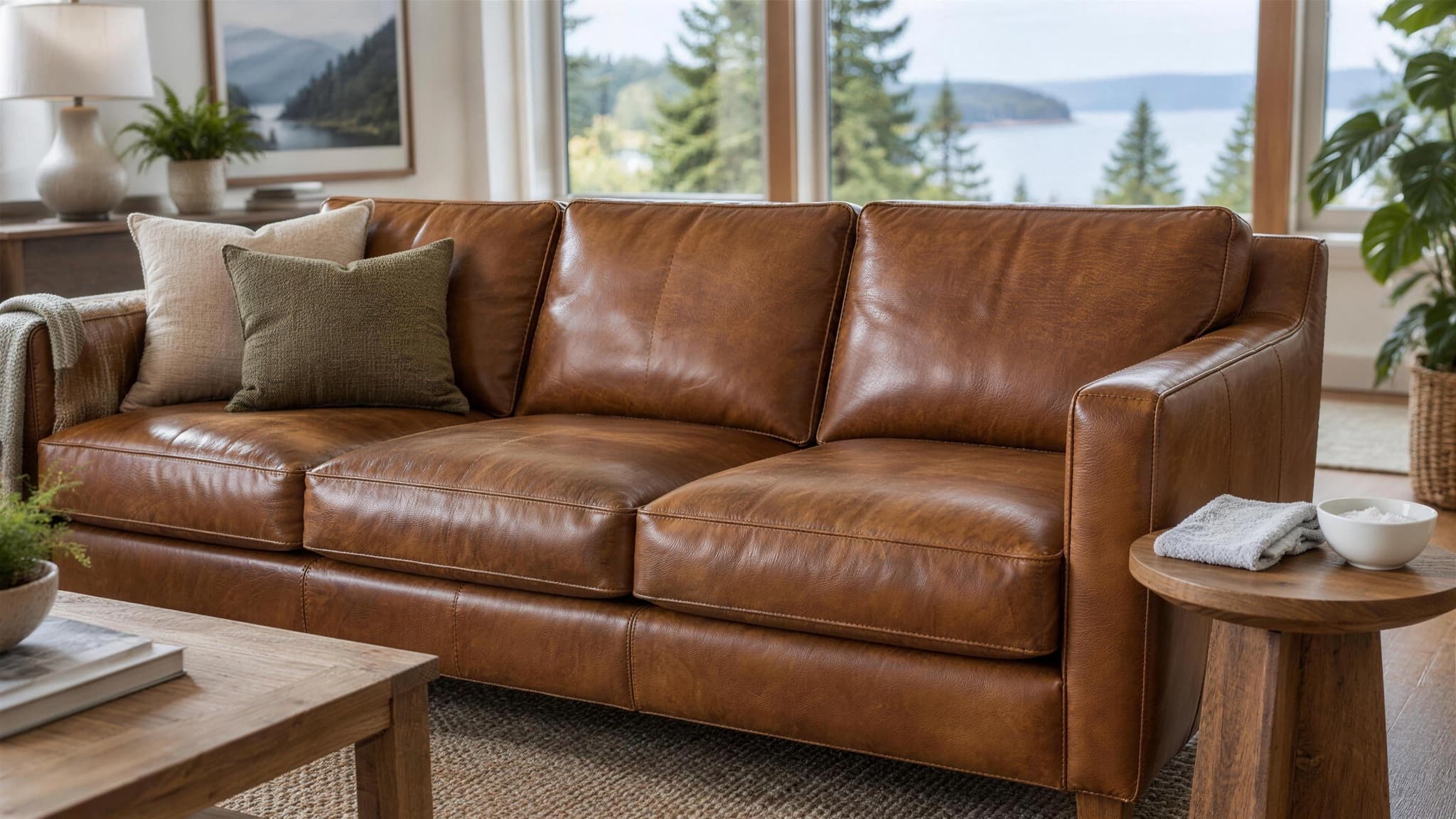
Leather is skin, and it behaves like skin. It has oils in it that keep it supple, a finish on top that protects it, and a tendency to dry out, stiffen, and crack when either one is stripped away. Almost every leather couch that gets wrecked by cleaning is wrecked the same way: someone used a product meant for a hard surface, it worked beautifully for a month, and then the seat cushions started to craze and peel.
The routine below is deliberately boring. Mild soap, distilled water, two cloths, a vacuum, and a conditioner a couple of times a year. It is what the tanneries and the furniture makers recommend, it is what our crews use on client sofas, and it is cheaper than anything in the cleaning aisle. The only skill involved is restraint.
Step one: find out which leather you have
Sofa leather comes in a few broad types, and the right cleaning method depends entirely on which one is in your living room. Check the care tag under a cushion or on the frame first; it often names the type outright. If the tag is long gone, the water-drop test will tell you.
Put a single drop of water on a hidden spot, the back of the sofa skirt or the underside of a cushion, and watch it for a minute. If it beads up and sits on the surface, you have protected leather with a pigmented finish, and everything in this guide applies. If it soaks in and darkens the spot, you have aniline or semi-aniline leather, which is far more absorbent and far less forgiving.
| Leather type | How to tell | How to clean it |
|---|---|---|
| Protected / pigmented | Uniform color, slight sheen, water beads up; the majority of family sofas | Vacuum, then mild soap and distilled water on a damp cloth; condition twice a year |
| Aniline | Visible grain and scars, buttery feel, water soaks in and darkens | Dry methods only: soft brush and vacuum; stains go to a specialist |
| Semi-aniline | Natural look with a light finish; water sits briefly, then slowly absorbs | Very lightly damp cloth, distilled water only, test first; condition sparingly |
| Bonded / faux leather | Perfectly even texture, plastic-like back on the fabric, peels in sheets when it fails | Damp cloth with mild soap; conditioners do nothing for it, so skip them |
Nubuck and suede are leather too, but with the surface buffed open; they want a dry nubuck brush and an eraser, not water, and they are outside this guide. If you are not sure which column your sofa belongs in, treat it as aniline until a hidden-spot test proves otherwise. Guessing wrong in the safe direction costs you a slower clean. Guessing wrong in the other direction costs you the couch.
Step two: the dry clean that does most of the work
Most of what makes a leather sofa look tired is dust and crumbs, and dust is abrasive. Every time someone slides across a seat, grit gets ground into the finish. A weekly dry pass removes it before it can do that, and it is the one step that works on every type of leather, including aniline.
- Pull the cushions and vacuum the frame with the soft brush attachment, never the bare plastic nozzle, which scratches
- Run the crevice tool along every seam and down the sides of the seat deck where coins, crumbs, and pet hair collect
- Wipe the whole surface with a dry microfiber cloth, working with the grain, to pick up the fine dust the vacuum missed
- Check the headrest, armrests, and the front edge of the seats: these touch skin and hair most and show the first oil darkening
If the sofa looks clean after this, stop here. Leather does not need a wet clean on a schedule the way a tile floor does; it needs one when it is actually dirty. Wet cleaning a leather sofa every week is how the finish wears thin.
Step three: the soap and distilled water wipe
This is the wet clean for protected leather, and only for protected leather. Mix a few drops of a mild, dye-free, fragrance-free liquid soap into a bowl of distilled water. Distilled matters: tap water carries minerals that dry to a faint chalky haze on dark leather, and the harder your water, the more obvious it is. Dip a microfiber cloth, then wring it until it is barely damp. If it drips, it is too wet.
Work one cushion or one arm at a time. Wipe in gentle overlapping strokes with the grain, without scrubbing, and watch the cloth: it will come away gray with body oil and dust film. Follow immediately with a second cloth dampened in plain distilled water to lift the soap residue, then a dry cloth to buff. Soap left on leather attracts dirt faster than bare leather does, which is why the rinse pass is not optional. Let the sofa air dry for an hour or two before anyone sits on it, away from heat and direct sun.
A commercial pH-neutral leather cleaner does the same job with the dilution already worked out, and it is a reasonable buy if you have a large sectional or a light-colored sofa that shows every mark. Either way, test on a hidden spot and wait for it to dry fully before judging; some finishes look darker when damp and go right back to normal.
What never goes on a leather couch
The products that damage leather are mostly products that work very well on other surfaces, which is why people trust them. Each of these strips oils, attacks the finish, or leaves a film, and the damage shows up weeks later as dullness, stiffness, and eventually cracks along the seat where the leather flexes most.
- White vinegar and any acidic cleaner: dulls and eventually breaks down the protective finish
- Rubbing alcohol, hand sanitizer, nail polish remover: pulls dye and oils straight out of the hide
- Baby wipes and disinfecting wipes: alcohol, fragrance, and surfactants that leave a dulling film
- Saddle soap: made for thick tack leather, too alkaline for the thin finished hide on furniture
- All-purpose sprays, degreasers, and anything with bleach or ammonia: built to strip, and they do
- Olive oil, coconut oil, and furniture polish: they go rancid, darken unevenly, and attract dust
The olive oil one deserves a mention because it circulates as a conditioning hack. Food oils do soften leather for a day, then they oxidize inside the hide, turn sticky, and leave blotchy dark patches that no cleaner will take out. A proper leather conditioner is a different chemistry, designed to stay stable in the fibers.
Stains, one at a time
Everything in this section assumes protected leather and a hidden-spot test first. On aniline leather, blot what you can with a dry cloth and call a leather specialist; the hide absorbs stains the way unsealed wood does, and home remedies usually set them permanently.
Drinks, food, and water-based spills. Blot immediately with a dry cloth; do not rub, which pushes the liquid into the seams. Then clean the spot with the soap and distilled water method and feather the edges outward so you do not leave a clean halo. If a water spot has dried into a ring, dampen the entire panel evenly with distilled water and let it dry slowly; the ring usually blends away because the whole panel is now drying at the same rate.
Grease and body oil. The dark, shiny patches on headrests and armrests are skin and hair oil that has soaked into the finish over months. A fresh grease spot, from buttered popcorn or a dropped slice of pizza, can be blotted and then dusted with cornstarch or baking soda for a few hours to draw the oil out before you wipe it away. Older oil darkening lightens with regular soap-and-water cleaning but rarely vanishes; a leather technician has stronger degreasers and the experience to use them without stripping the color.
Ink. This is the one to leave alone. The internet will tell you rubbing alcohol or hairspray, and both dissolve the ink, then spread it across a wider area while taking the finish with it. On protected leather, a pen mark sometimes lifts with a leather-specific ink remover applied with a cotton swab, only on the mark, only after a test. If it does not come up in one careful attempt, stop. Repeated attempts turn a small mark into a bare patch that needs re-dyeing.
Pet accidents. Blot thoroughly, clean with soap and distilled water, and then deal with the odor, which is what brings the dog back to the same spot. An enzyme cleaner labeled as safe for leather, tested first, breaks down the proteins that cause the smell. Urine that reached the cushion foam is a different problem: the leather cover may need to be unzipped and the foam replaced or treated separately.
Mold and mildew. Rare on a sofa in a lived-in room, common on one that spent a winter in an unheated garage or basement. Move it somewhere dry and ventilated, vacuum the surface growth, and wipe with the soap and distilled water method. The EPA's mold guidance applies here as it does everywhere: unless the moisture source is fixed, it comes back, and a sofa that is still damp inside the cushions should not come back into the house.
Conditioning, and how often it really needs doing
Cleaning removes dirt; conditioning replaces the oils that slowly leave the hide through normal use and dry air. For a protected leather sofa in an ordinary room, once or twice a year is enough. Pick a water-based conditioner made for furniture, apply a thin coat with a clean cloth, let it absorb for the time on the label, then buff off the excess. Thin is the point. A thick coat does not soak in; it sits on top, feels tacky, and collects dust and pet hair.
Condition more often if the sofa lives a hard life: next to a wood stove or a forced-air register, in a sunroom, or in a house that runs the heat dry all winter. Around the Puget Sound region the damp months are gentle on leather, and it is the heating season, roughly November through March, when hides dry out. A conditioning pass in late fall and another in spring lines up with that cycle. Aniline leather takes conditioner too, but test it; it absorbs unevenly and can go blotchy. Bonded leather does not absorb anything, so skip it.
Where the couch sits matters as much as how you clean it
Sun fades leather and heat dries it, and most of the cracked sofas we see were parked in front of a south-facing window or a heat source for years. If the layout allows, keep the sofa a couple of feet from registers and fireplaces and out of direct afternoon sun, or use a sheer curtain during the brightest hours. Rotating the seat cushions every month, if they are reversible, spreads the wear and the fading so one cushion does not end up a shade lighter than its neighbor.
A couple of smaller habits add up. Keep newspaper and dark denim off light leather, both transfer dye. Put a throw on the spot where the dog sleeps rather than fighting the oil darkening afterward. And if the sofa is leather on the front and vinyl or fabric on the back and sides, which is common in mid-range furniture, clean those panels with their own method; the vinyl in particular tolerates a damp all-purpose wipe that the leather front does not.
A leather couch cleaning schedule
Spread out like this, none of it is a project. The weekly pass is a few minutes with the vacuum, and the wet clean happens only when the sofa actually looks like it needs one.
| Frequency | What to do |
|---|---|
| As it happens | Blot spills with a dry cloth within minutes; do not rub |
| Weekly | Vacuum with the soft brush, crevice tool in the seams, dry microfiber wipe |
| Every 1 to 3 months | Soap and distilled water wipe with the rinse pass, when the headrests and arms start to look dull |
| Twice a year | Full clean, then a thin coat of leather conditioner; rotate the cushions |
If you are building a routine for the whole house rather than one sofa, our house cleaning schedule slots furniture care in alongside the floors and bathrooms, and the deep cleaning checklist covers the twice-a-year jobs. The same water-drop logic shows up in our guide to cleaning hardwood floors; sealed and unsealed surfaces need different treatment, and a thirty-second test tells you which one you have.
What our crews do with leather, and what they leave to a specialist
On a recurring visit, leather furniture gets the dry treatment: vacuumed with the brush attachment, seams cleared, surface dusted with the grain. If you ask for it, protected leather gets the soap and distilled water wipe with the rinse pass. What we will not do is stain removal on aniline leather, ink work, or anything involving dye and finish repair; that belongs with a leather restoration technician, and we would rather tell you so than practice on your sofa.
Our home cleaning service covers the living room, kitchen, bathrooms, and floors on every visit, starting at $150 with the same cleaner every time. We're a background-checked, bonded and insured crew that has cleaned 1,200+ Puget Sound homes since 2022, now serving north King, Snohomish & Skagit counties, and every visit is backed by a 100% satisfaction guarantee. You can get a flat quote in about 60 seconds.