
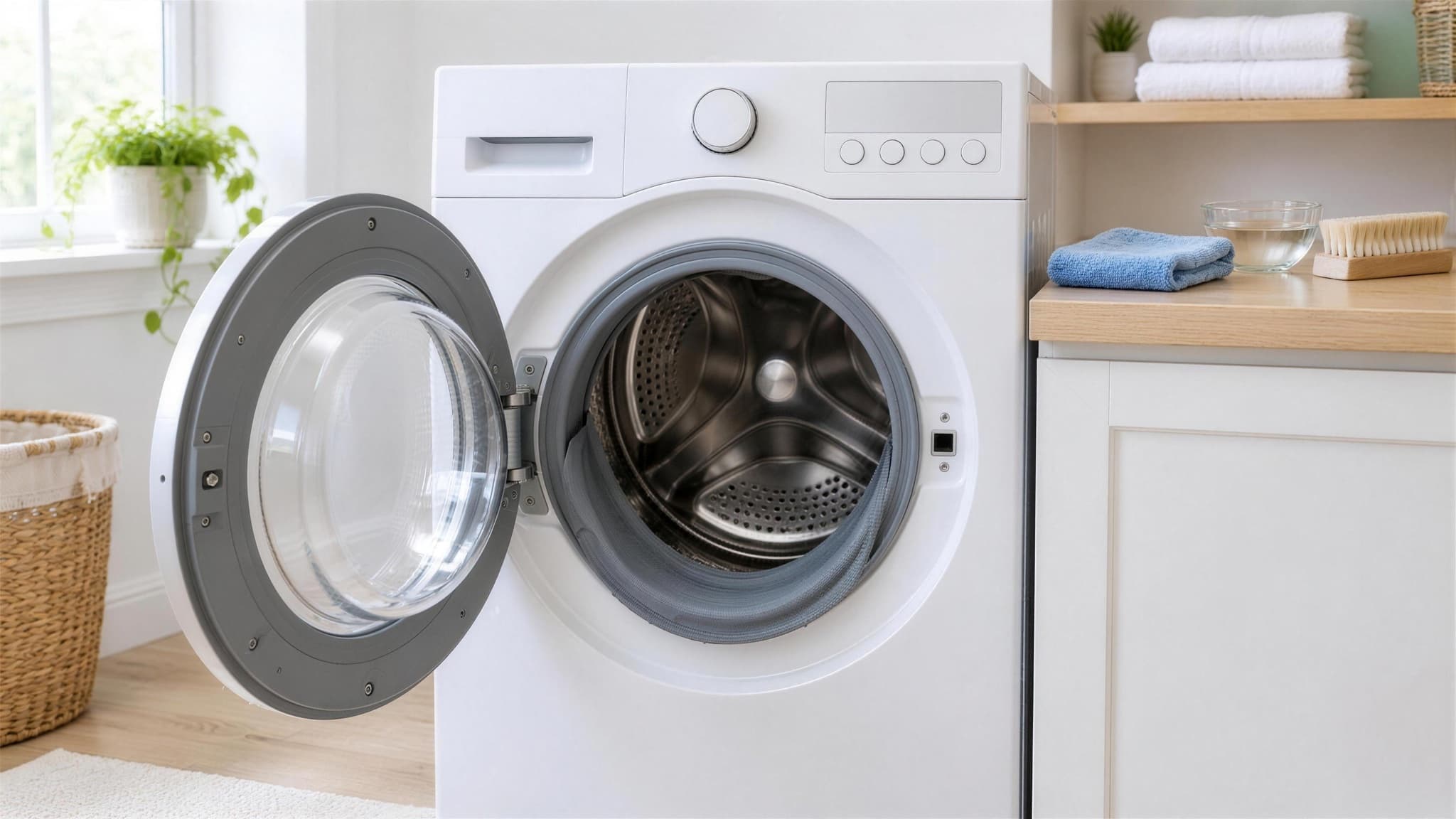
A washing machine spends its life full of hot water and detergent, so it is easy to assume it rinses itself clean along with the clothes. It doesn't. Every load leaves behind a thin film of detergent, fabric softener, skin oil and lint, and that film settles in the places water never fully drains from: the folds of the door seal, the back of the dispenser drawer, and the pump housing at the bottom of the machine. Closed up warm and wet between loads, those spots grow exactly what makes towels smell musty straight out of the dryer.
The fix costs almost nothing. Everything below uses dish soap, white vinegar or household bleach, an old toothbrush and a few towels. The two things to get right are the order, hand-clean the hidden parts before any cycle, and the chemistry: vinegar or bleach, one per session, never together.
Front load vs. top load: where the grime hides
The two designs collect dirt in different places, which is why a routine written for one machine leaves the other half-cleaned. A front loader seals with a thick rubber gasket, called the boot, around the door opening. Water pools in its lower fold after every cycle, and the fold is dark, warm and full of lint, so it is the number one source of black mildew spots and the smell that comes with them. Front loaders also use far less water, which is good for the bill and bad for rinsing residue out of the drum.
A top loader has no boot, so its problem areas are the rim under the lid, the cavity between the inner basket and the outer tub where you cannot see, and the agitator or impeller at the center of the drum. Older top loaders with a central agitator hide a surprising amount of lint and softener scum under the cap. High-efficiency top loaders without an agitator behave more like front loaders: low water, more residue, and a Tub Clean cycle in the menu for exactly that reason.
Step one: the gasket and the drum
Start with the machine empty and the door open. On a front loader, pull the rubber boot toward you so the inner fold opens up, and run a cloth around the whole channel. You will find lint, hair, grit, sometimes a hair tie or a coin, and a slick grey film along the bottom. Warm water with a few drops of dish soap on a cloth lifts the film; an old toothbrush handles the stained patches. Dry the channel with a towel when you are done, because leaving it wet is how the problem started.
- Fold the boot outward and wipe the full inner channel, not just the visible lip
- For black spotting, lay a cloth dampened with diluted bleach against it for 10 minutes, then rinse and dry
- Wipe the glass or metal inside the door and the lip of the drum where softener leaves a waxy ring
- On a top loader, lift the agitator cap if it pulls off and clean the lint and scum underneath
- Wipe the underside of a top loader lid and the rim of the outer tub, where softener collects
- Skip abrasive pads and powders: they scratch the drum and the boot, and scratches hold grime
If a boot is cracked, torn, or the black staining has sunk below the surface of the rubber so it will not wipe or bleach away, the gasket is a replaceable part on nearly every front loader, and a new one is far cheaper than living with the smell.
Step two: the dispenser drawer and the cavity behind it
Most dispenser drawers pull all the way out: slide it open, press the release tab (usually a blue or marked lever in the softener compartment), and lift. Soak it in the sink in hot water with dish soap for ten minutes, then scrub the corners with the toothbrush. The softener siphon cap, the small cover that lifts off the middle compartment, is where the thick blue jelly hides; pull it off and clean both pieces. Caked detergent that will not soak off softens with a few minutes in very hot water.
With the drawer out, shine a light into the housing it came from. The roof of that cavity has a row of water jets, and the whole space is usually coated in black and pink film that nobody has ever seen. A toothbrush and a damp cloth reach most of it; a long thin bottle brush reaches the rest. This cavity is the second most common source of a mildew smell after the gasket, and it is the one almost every guide skips. Dry the drawer, reseat it, and leave it ajar between loads from now on.
Step three: the pump filter nobody told you about
Front loaders have a small filter ahead of the drain pump that catches whatever the drum lets through: lint, hair, coins, hair pins, the odd sock. It sits behind a little door or kick panel at the bottom front corner. A cup or two of water is trapped in that housing at all times, and when it sits for weeks it turns into the sour, stagnant note under the mildew smell. A machine that takes longer and longer to drain, or throws a drain error, is nearly always telling you about this filter.
Lay old towels down and set a shallow tray or baking dish under the door. If there is a small drain hose next to the cap, pull it out, remove its plug and let it run into the tray. If not, unscrew the cap a quarter turn at a time until water starts trickling, and let it finish before opening the cap fully. Pull the filter, rinse it under the tap, pick out the debris, wipe the inside of the housing with a cloth, check the pump impeller behind it spins freely, and screw the cap back in until it is snug. Top loaders mostly skip this part: few have a user-serviceable pump filter, and the lint trap on those that do is in the manual.
Step four: the hot cleaning cycle
Now the machine can clean the parts you cannot reach: the back of the drum, the outer tub, the hoses and the pump. Pick one of the three options in the table and run the hottest, longest cycle available with the drum empty, or the Tub Clean or Self Clean program if your machine has one. On a front loader, vinegar goes in the detergent compartment and bleach goes in the bleach compartment; on a top loader, either one goes straight into the drum once it has started filling.
| Method | What it does | The catch |
|---|---|---|
| White vinegar, 2 cups | Dissolves mineral scale and the waxy detergent and softener film that holds odor | Monthly, not weekly; some manuals advise against acid on rubber parts |
| Chlorine bleach, 1/2 cup | Kills mold and bacteria in the tub and hoses; the manufacturer's usual pick | Run an extra empty rinse after it; never in the same session as vinegar |
| Washer cleaner tablet | Oxygen bleach plus citric acid; same job, gentler on seals | Costs money; still does not reach the gasket, drawer or filter |
| Baking soda, 1/2 cup | Deodorizes and brightens a dull drum | A separate short cycle after vinegar, never mixed with it in the same run |
The one hard rule: bleach and vinegar never meet. Mixed, or run back to back without a rinse between them, chlorine bleach and an acid release chlorine gas, which is dangerous in a small laundry room with the door shut. Choose one for this month and the other for next, and run an empty rinse after any bleach cycle so none of it reaches your next load of darks. When the cycle ends, wipe the gasket and drum dry one more time and leave the door open.
Fixing a washing machine that still smells
If the full routine above does not clear the smell within a load or two, the cause is usually one of three habits rather than dirt. The first is detergent overdose. A high-efficiency machine needs a small amount of HE detergent, usually two tablespoons or less for a normal load, and the measuring cup on most bottles holds several times that. Excess detergent does not rinse out; it builds the film the mold grows on. Cut the dose in half for a month and see what happens.
The second is cold-water washing for every load. Cold water saves energy and is right for most clothes, but it never strips the residue that warm water would. One warm or hot load a week, towels and bedding are the natural choice, keeps the drum clearer. The third is fabric softener, which is essentially a wax that coats the drum, the drawer and the boot, and feeds the growth. Dryer balls or a splash of vinegar in the softener compartment do the same job for towels without the coating. If the smell is sour and drain-like rather than musty, check that the standpipe the drain hose feeds into is not clogged and that the hose is not pushed so far down that it siphons dirty water back.
Mold in the laundry room, and what the machine is telling you
Black spotting on a gasket and pink film in a drawer is the same mold-and-moisture story as the bathroom, just in a smaller space. The EPA's guide to mold and moisture comes down to the same principle everywhere in the house: clean the surface, dry it, and remove the moisture source, or it returns. For a washer that means the hand-cleaning steps, the hot cycle, and then the door-open habit. If the room itself smells musty, the machine is often the symptom rather than the cause: a laundry room with no exhaust fan, a dryer vent that leaks warm damp air behind the machines, or a slow drip at the supply hoses keeps the whole space humid. Pull the machines out once a year, check the hoses and the floor behind them, and vacuum the lint off the dryer duct while you are there.
How often to clean a washing machine
Once the machine has been reset with the full routine, none of this takes long. The rhythm below keeps each session to a few minutes because nothing ever gets months to build up.
| Frequency | What to do |
|---|---|
| Every load | Wipe the boot, leave the door and drawer open, do not leave wet laundry sitting in the drum |
| Weekly | Run at least one warm or hot load; check the boot fold for socks, hair ties and lint |
| Monthly | Gasket scrub, dispenser drawer and cavity, hot cleaning cycle with vinegar or bleach |
| Every 3 months | Drain and rinse the pump filter; wipe the exterior, control panel seams and the top of the machine |
| Yearly | Pull the machine out, inspect supply hoses and the floor, clean the dryer duct beside it |
If you are building a rhythm for the whole house rather than one appliance, our house cleaning schedule slots the monthly washer clean next to the dishwasher and the oven, and the deep cleaning checklist covers the laundry room walls, floor and dryer that only need attention a few times a year.
Leave the rest of the house to us
The washer is a twenty-minute job once a month, and the machine runs the last step on its own. What quietly eats a weekend is everything around it: the laundry room floor under the lint, the dryer top, the utility sink, and then the kitchen and bathrooms waiting down the hall. A recurring clean keeps that whole loop under control, so the monthly washer routine is the only laundry chore that stays on your list.
Our home cleaning service covers the laundry room, kitchen, bathrooms, appliance exteriors and detail work on every visit, starting at $150 with the same cleaner every time. We're a background-checked, bonded and insured crew that has cleaned 1,200+ Puget Sound homes since 2022, now serving north King, Snohomish & Skagit counties, and every visit is backed by a 100% satisfaction guarantee. You can get a flat quote in about 60 seconds.